
research
Assessment of cancer biomarkers in the Grenfell firefighter cohort study
Dr Jen Canizales research visit to Italy
Sat, 01 Mar 2025
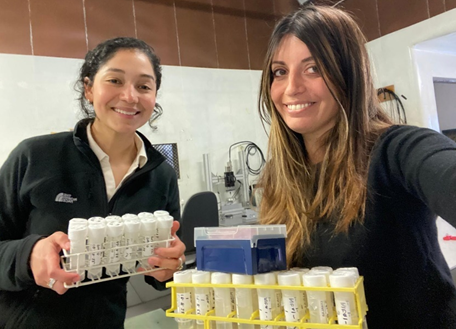
In March, supported by a Horizon Europe grant led by Dr Elaine Fuertes, Dr Jen Canizales spent two weeks in Italy training in spectrometry techniques to improve airborne allergen analysis. She was supervised and guided by Dr Gabriela Graziani (Politecnico di Milano, Università di Bologna) and Prof Laura Riva (Politecnico di Milano). Whilst there, Jen gave a presentation on the work carried out by the OEM Laboratory Service to staff at students at Politecnico di Milano.
ERS Congress 2025
Sat, 27 Sep 2025
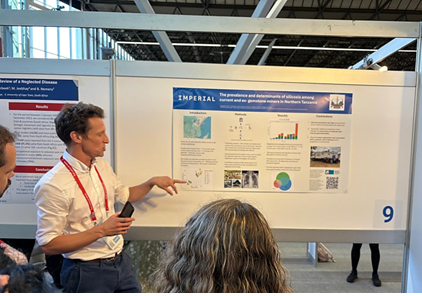
Dr Patrick Howlett and Dr Johanna Feary both attended the ERS Congress 2025 in Amsterdam, the Netherlands.
Patrick also did a poster presentation on his current research on "the prevalence and determinants of silicosis among current and ex-gemstone miners in Northern Tanzania" (PA1579).
Lab research featured on CBS News
Wed, 03 Apr 2024
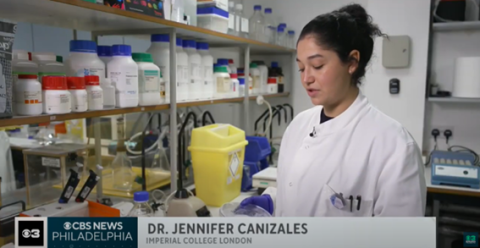
Dr Jen Canizales from our laboratory has been collaborating with Dr Elaine Fuertes from Imperial College London on a project to improve the tracking of airborne pollen allergens. The goal is to provide hay fever sufferers with better tools to manage their symptoms. The project was recently featured on CBS News — you can read the article and watch the news clip using the links below:
Patrick Howlett shortlisted for MRC Max Perutz Science Writing Award 2025
Fri, 28 Nov 2025

Dr Patrick Howlett was shortlisted for the MRC Max Perutz Science Writing Award 2025 for his article on why his area of research matters, titled "Silicosis and tuberculosis: half the world away".
The annual award has been running for 27 years, and is a science communication competition for current MRC PhD students.
Patterns of mouse allergen–specific IgE and IgG4 in contemporary animal research environments
Laboratory animal allergy (LAA) results from occupational ex-posure to allergens found in the hair, dander, urine, and salivaof laboratory animals. It presents as work-related rhinocon-junctivitis and occupational asthma after a latency period of2–3 years. Prevalence of rodent-sensitisation among laboratoryanimal (LA) workers ranges between 10.4% [1] and 28% [2].Though exposure is a major risk factor, some individuals developallergen-specific IgE without progressing to LAA symptoms andare considered clinically tolerant [3].
Publication on Grenfell Firefighters Study
Wed, 07 May 2025
The Grenfell Firefighters Study is a cohort study of firefighters from the London Fire Brigade to look at the medium and long term risks associated with firefighting, with a particular emphasis on cardiorespiratory health and cancer. The cohort includes both firefighters who did, and did not attend the Grenfell Tower fire in 2017. Recruitment began in late 2019 and finished in 2023.
UK Silicosis Registry
In 2026, we set up the UK Silicosis Registry (UK SR) supported by funding from the RBHH Charity. The UK SR is based at Imperial College London.
A Registry is like a survey that collects health information about people with a specific medical condition. In the UK SR, these are people with silicosis who have developed the condition from exposure to silica dust in their jobs. Bringing together information on people across the UK means we can better understand silicosis and how best to treat it. We can also compare patients with silicosis in the UK with those in other countries.
This is an observational study, which means we are not testing any new treatments but instead collect information about work histories, medical histories and test results recorded during usual clinic visits with your respiratory clinical teams. The data is pseudo-anonymised so that individuals cannot be identified.
At the moment, only patients seen in the Royal Brompton Hospital Occupational Lung Disease clinic are able to take part but the plan is to expand this to other services around the UK in the near future.
For further information on the study, please contact the chief investigator Dr Johanna Feary (j.feary@imperial.ac.uk).
