

Dr Jennifer Canizales
Dr Jen Canizales research visit to Italy
Sat, 01 Mar 2025
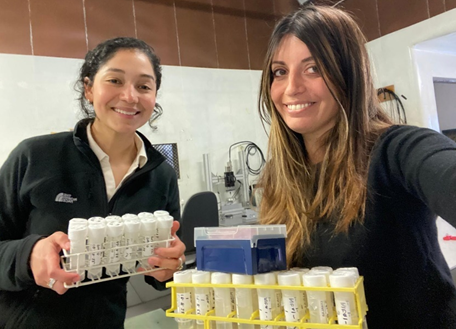
In March, supported by a Horizon Europe grant led by Dr Elaine Fuertes, Dr Jen Canizales spent two weeks in Italy training in spectrometry techniques to improve airborne allergen analysis. She was supervised and guided by Dr Gabriela Graziani (Politecnico di Milano, Università di Bologna) and Prof Laura Riva (Politecnico di Milano). Whilst there, Jen gave a presentation on the work carried out by the OEM Laboratory Service to staff at students at Politecnico di Milano.
Dr Jennifer Canizales
Laboratory Development Manager

Dr. Jennifer Canizales runs the Occupational and Environmental Medicine Lab Service at the National Heart and Lung Institute (NHLI), where she oversees diagnostic services for occupational respiratory diseases. Her work focuses on developing new immunological assays and collaborating with researchers at Imperial College and other institutions on environmental health research.
Prior to this, Jennifer worked on malaria serosurveillance projects at the London School of Hygiene & Tropical Medicine and contributed to allergy research with the SPIRAL study at Imperial College London. Today, she combines lab management with ongoing research to improve diagnostic techniques in occupational respiratory disease.
- Phone: +44 (0)207 594 7930
- Email: j.canizales@imperial.ac.uk
- ORCID: 0000-0003-1329-3060
- See a list of recent publications by Dr Jennifer Canizales
Lab research featured on CBS News
Wed, 03 Apr 2024

Dr Jen Canizales from our laboratory has been collaborating with Dr Elaine Fuertes from Imperial College London on a project to improve the tracking of airborne pollen allergens. The goal is to provide hay fever sufferers with better tools to manage their symptoms. The project was recently featured on CBS News — you can read the article and watch the news clip using the links below:
Laboratory animal allergy is preventable in modern research facilities
Measurement of specific IgG4 anti-mouse urine antibodies
IgG4 and its role in immune tolerance has been investigated widely. Symptom reduction and improved clinical outcomes in immunotherapy trials are associated with significant increases in allergen-specific IgG4 antibodies. Natural immune tolerance observed in beekeepers and cat owners has also been associated with elevated levels of bee venom and cat allergen-specific IgG4, respectively. Functionally, allergen-specific IgG4 has been shown to reduce the binding of IgE-allergen complexes to B cells, a key step in the initiation of the type 1 hypersensitivity allergic response.
Patterns of mouse allergen–specific IgE and IgG4 in contemporary animal research environments
Laboratory animal allergy (LAA) results from occupational ex-posure to allergens found in the hair, dander, urine, and salivaof laboratory animals. It presents as work-related rhinocon-junctivitis and occupational asthma after a latency period of2–3 years. Prevalence of rodent-sensitisation among laboratoryanimal (LA) workers ranges between 10.4% [1] and 28% [2].Though exposure is a major risk factor, some individuals developallergen-specific IgE without progressing to LAA symptoms andare considered clinically tolerant [3].
