Silicosis
Artificial stone silicosis: A UK case series
Silicosis due to artificial stone (AS) has emerged over the last decade as an increasing global issue. We report the first eight UK cases. All were men; median age was 34 years (range 27–56) and median stone dust exposure was 12.5 years (range 4–40) but in 4 cases was 4–8 years. One is deceased; two were referred for lung transplant assessment. All cases were dry cutting and polishing AS worktops with inadequate safety measures. Clinical features of silicosis can closely mimic sarcoidosis.
ARTIST study
Coming soon near you!
What is the ARTIST study?
The ARTIST study aims to answer some key questions relating to silica exposure in UK worktop fabricators.
The study will include making measurements of exposure to fine silica dust in workplaces and examining the lungs of workers to investigate how silica exposure may be affecting the health of workers in this industry.
Who is involved?
Imperial College is leading the research in collaboration with the Worktop Fabricators Federation (WFF), University of Manchester and IOM Consulting Limited.
Who is funding this research?
The research is funded by the National Institute for Health Research and the Colt Foundation.
What will it involve?
Researchers will visit fabricating companies who are members of WFF and:
• Invite workers to take part in the study which includes a lung scan and blood/urine tests
• Carry out and provide a report of silica measurements at each workplace (in association with the IOM)
How much will it cost my business?
Taking part, including the report of silica measurements, is free of charge.
Will my results be shared with HSE?
We will not share individual reports with the Health & Safety Executive (HSE).
What happens next?
More information will be provided once the study has formally launched. In the mean time, please contact us if you have any questions or to register your interest (Chief investigator: Dr Jo Feary: ARTISTstudy@imperial.ac.uk or IOM: info@iom-world.org).

BTS Winter Meeting 2025
Wed, 26 Nov 2025

The Lungs at Work team attended, presented and chaired at the most recent British Thoracic Society (BTS) Winter Meeting between 26-28 November 2025 in Westminster, London.
Our team presented the following abstracts:
Concentrations of respirable crystalline silica and radon among tanzanite mining communities in Mererani, Tanzania
Background
Globally, the number of small-scale miners (SSM) is estimated to be more than 25 million, but it supports the livelihoods of around 100 million individuals. In Tanzania, the number of SSM has increased from an estimated 150,000 in 1987 to ~1.5 million in 2017. The miners are at a high risk of occupational-related health challenges. The study aimed to assess the concentrations of respirable crystalline silica (RCS) and radon among the tanzanite mining communities in Simanjiro District, Tanzania.
Confronting the growing epidemic of silicosis and tuberculosis among small-scale miners
An estimated 49·5 million small-scale miners worldwide are exposed to high concentrations of silica during their work. The substantial morbidity and mortality of silicosis and tuberculosis among workers exposed to such intensities have been documented. This Viewpoint raises concern at the failure to respond to a growing epidemic of lung disease (predominantly silicosis and tuberculosis) among small-scale miners.
Dr Jo Feary featured in iNews campaign on artificial stone silicosis
Mon, 04 May 2026

Dr Jo Feary has been quoted in a recent article published by the iPaper about silicosis due to artificial/engineered stone ("More young men ‘will die’ of kitchen revamp disease as cases go undetected titled" - iPaper, 4th May 2026)
ERS Congress 2025
Sat, 27 Sep 2025
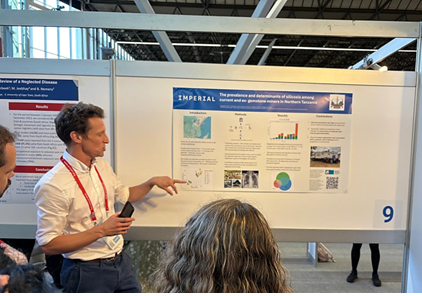
Dr Patrick Howlett and Dr Johanna Feary both attended the ERS Congress 2025 in Amsterdam, the Netherlands.
Patrick also did a poster presentation on his current research on "the prevalence and determinants of silicosis among current and ex-gemstone miners in Northern Tanzania" (PA1579).
Health effects of silica dust
Wed, 07 May 2025
We have worked with the Society of Occupational Medicine (SOM) to develop an information document on silicosis from artificial/engineered stone. The document aims to provide background information and practical strategies for occupational health surveillance.
ITV News feature on silicosis from artificial stone
Thu, 04 Jun 2026
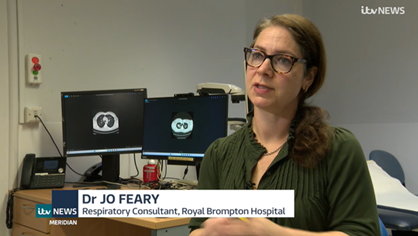
Media coverage continues for on the rise in cases of silicosis amongst workers, primarily stonemasons, caused by exposure to artificial/engineered stone.
ITV News recently aired a piece on Monday 1 June 2026 focusing on a widow who lost her husband to silicosis, and the dangers of working with artificial stone.
Lungs At Work team member Dr Jo Feary was also featured in the report, and continues to do a huge amount of work to raise awareness and understanding of silicosis due to artificial stone.
Jo Feary featured in iNews campaign on artificial stone silicosis
Tue, 16 Dec 2025

The i Paper has recently published several articles about silicosis due to artificial/engineered stone. The articles are part of a wider campaign to raise awareness of the dangers of working with this type of stone, and to improve health surveillance and accountability of UK employers which are still using these products. The i Paper is ultimately calling for ban of artificial/engineered stone in the UK.
